Wednesday, February 20, 2008

Aspects of the Blog

E.M Forster’s wrote Howard’s End and A Passage to India. He’s (post)Edwardian, which means early 20th Century. He gets lumped in with the Modernists sometimes because he was writing round the same time as James Joyce and Virginia Woolf, but he’s much more traditionalist (i.e. Victorian). Not much in the way of wacky formal experiments for Forster. He respected wacky formal experiments, even if he didn’t indulge himself.

I’m not being obscure when I chat about Forster. Really. He’s significant. He’s somebody. He wrote this book called Aspects of the Novel. Actually, that’s not true. He delivered a series of lectures about literature called Aspects of the Novel at Cambridge in 1927 and they were collected into this book. He lectured once a week about a different aspect of “the novel,” and what he says has become common currency in creative writing programs.

We learn from Forster that “story” is an unfortunate necessity in fiction writing, an aspect that appeals to mere curiosity. We learn that fiction is really about human beings, and Forster expends a good deal of talk musing on authentic character and the difference between flat and round characters (probably his most notable contribution to the canon of creative writing craft writing, though his ideas have been challenged from time to time, most recently by James Wood in this Guardian article).

We learn that even though novels are about human beings and the truths about human nature and human value that fictional characters exhibit, novels also have a bunch of other stuff that competes with this “pure” depiction of humanity. You can’t just go showing humanity. You’ve got to tell a story, fashion a plot, use language, and exhibit pattern and rhythm. All of these things, in a sense, get in the way of showing character, but they’re what make fiction fiction. Character and form, constant competition. The trick for the writer is to find the balance.

Forster also tells us that every aspect of the novel makes different demands on the reader. We readers know these demands and enjoy them, like good little masochists, so we don’t mind. Story—that is, wanting to know what happens next—makes no real demands; it just appeals to our curiosity. Even a caveman can do story.

The demands come in when character is introduced. Once a writer gives us a character, we readers are expected to engage with that character according to our own human feelings (i.e., empathy) and our sense of human value (i.e., our ethical system). If we have no empathy or ethics, we’re not going to give a shit about fictional characters.

Plot is not story, exactly. Plot is the deliberate fashioning of story in order to emphasize causality. One event causes another, though not necessarily in chronological order. Even in a novel as inane as The DaVinci Code, plot is carefully constructed. In fact, you might argue that some of the most ingenious plotting occurs in novels that are often dismissed for being genre garbage. Why this highbrow scoffing at plot? Because plot is more prone to formula than other aspects—or at least more recognizably so. Because plot comes from the head, not from the heart, like authentic character does. Or so they say.

Anyway, with plot, cues and clues lead us to further revelation and realizations. What happened before the story begins is gradually revealed as the story itself progresses. In that basic sense, two “stories” form a plot (this, by the way, is the basic structure of most mysteries). You have the story that unfolds chronologically from the discovery of the body to the punishment of the murderer. But you also have the other story, often broken out of its chronology and sprinkled throughout the chronological story, of what happened before the body is found—the story behind the murderer’s motivation, the exposition.

Forster says plotting makes demands on the reader’s intelligence and memory, and this makes perfect sense to me. The more plot a book has, the more it demands of our ability to unravel conspiracies and make connections (intelligence) and our ability to remember names, clues and motivations (memory). You can’t be stupid and read James Ellroy. It’s not his complex ideas that hurt. After all, Ellroy’s idea is essentially: everybody’s guilty and we always have been. Instead, it’s the complex structure of his plots: hundreds of characters, dozens of motivations and interlocking crimes and conspiracies.

I read Forster’s Aspects the first time back when I was an undergrad. What I’ve said so far is basically what I came away with, what I figure most folks come away with. Lots of good nuggets of advice, though Forster doesn’t really package them as bits of advice to writers so much as cool stuff to notice about how great books work. Aspects: a time well spent for everybody involved.

But the thing is: Forster adds two “aspects” into the middle of the book that throw his whole treatise into confusion. These aspects are “fantasy” and “prophecy.” He devotes a chapter to each. These chapters are so daunting and difficult, you get an overwhelming urge to dismiss them altogether—concentrate instead on the chapters that made sense. This is exactly what I did when I was an undergrad. I was baffled; I moved on. But now, years later, I feel ready to tackle those two chapters. Not because I want the trivial satisfaction of having understood them (though that’s fun), but because I think Forster might get closer in these two chapters than anywhere else to the real reason good fiction is so powerful and memorable for the reader. The great secret is here, man.

Every craft book you read discusses story, character, plot, pattern and rhythm—just like Forster does. But no book I’ve ever read discusses “fantasy” and “prophecy,” at least not the way Forster does, and not with the same terminology. Lots of craft books and essays cite Forster’s seminal ideas on the more basic aspects of the novel, though I’ve never seen one that mentions these two pesky aspects, “fantasy” and “prophecy”. He devotes two chapters, a whole third of the book, to them. So what’s the big deal?

Well, for one, what he says is not “nugget-like.” You can't take it away and make a rule out of it like: “plot should emphasize causality,” or: “important characters should be round and not flat.” You can’t say: “one should attempt to write fantastically or prophetically” and hope that anyone has a clue what you mean. There’s no prescription here. There’s only Forster noticing that some of the greatest writers in history were doing a little something extra beyond just creating truthful/meaningful characters and fashioning ingenious plots and writing well. He suggests, though he doesn’t ever come out and say it, that we apprentice writers might want to consider this other stuff if we too want our novels to be remembered by posterity (which is not nearly the same as the desire to make it to the bestseller list, mind you).

So what is “fantasy” and what is “prophecy”? Ask two people and you’ll get two different answers. Forster himself is not totally sure, in part because he thinks all great writers are completely unique in their vague exhibition of fantasy and prophecy. Melville does it one way, Joyce another, Emily Bronte yet another. He can’t really define either one, but he knows them when he sees them, much like that congressman and his definition of pornography.

Of the prophet-writer in general (and D.H. Lawrence specifically), Forster admits: “what is valuable about him cannot be put into words.” No amount of logical analysis will help us understand either, because when we read the prophet or fantasist writer we must “lay aside the single vision which we bring to most literature and life . . . and take up a different set of [analytical] tools.” In fact, these new tools aren’t even analytical because logical analysis won’t help us understand fantasy or prophecy.

Fantasy and prophecy sure as hell can’t be taught, at least not in a craft lecture. They can be taught by making apprentice writers read Moby Dick and The Brothers Karamazov and Wuthering Heights and Ulysses and hoping said apprentices imbibe some of the spirit that lingers there (but also make their own versions—no fake, disappointing copycatting).

The problem of defining fantasy and prophecy is also exacerbated by the fact that Forster doesn’t define either word the way we normally would. A “fantasist” writer is not necessarily one who writes fantasy/sci fi/ supernatural horror literature, like J.K. Rowling or Tolkien or Ursula LeGuin or Clive Barker or Anne Rice. Forster’s definition of “fantasy” includes all this stuff, but extends beyond it, into literature that would be considered realistic or “literary,” that would never be placed on a genre rack in the bookstore. His cryptic definition of fantasy: “it implies the supernatural but need not express it.”

Similarly, the prophetic writer is not one who writes about what he believes will happen in the future. Prophecy, for Forster, doesn’t have anything to do with prediction. It doesn’t have anything to do with making any kind of statement at all— forwarding a logical world view. Therefore, prophecy is also not about establishing moral or ethical groundwork. The first sentence of Forster’s prophecy chapter goes, “With prophecy in the narrow sense of foretelling the future we have no concern, and we have not much concern with its appeal for righteousness.” This negative definition cancels out the Jesus image we might get in regards to the prophet: the moral bastion, the sage. That ain’t what he means.

Okay, so we know what fantasy and prophecy are not, but does this help us understand what they are? Nope. Every apprentice writer who reads these two chapters in Aspects will get—if he gets anything at all—a different understanding. Mine is no better than yours, even if I’ve been considering mine for a while. And—at the risk of overstaying my welcome—I’ll wait till tomorrow to take the egomaniacal step of telling you what I think Forster means by “fantasy” and “prophecy.” Or, at least, I’ll tell you what I want him to mean. Isn’t that exciting?

Tuesday, February 12, 2008

Some Ecstasy from the Agony

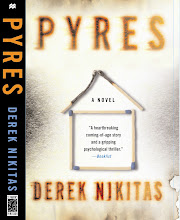
This morning, Terry D'Auray over at "The Agony Column Book Review and Commentary" has posted a wonderful review of my novel Pyres. To quote E of the Eels: "It was more than I thought I deserved." My biggest challenge in writing Pyres was trying to "mind-meld" with female characters who bear no resemblance to me, so I'm humbled any time anyone praises the effort.

Anyway, the D'Auray review heralds the second time I've been compared to John Connelly, whom I have admittedly not yet read, even though his novel Every Dead Thing begins with an epitaph from John Donne's poem, "A Nocturnal Upon St. Lucy's Day, Being The Shortest Day," being the poem from which Connelly took his titular phrase. For reasons clear to those who've read Pyres, I would've used that same epitaph to begin my book, had not Mr. Connelly beat me to the punch. Do I hold a grudge? Of course not!

I must also admit I've not heard of this wonderful website, "The Agony Column..." until today, and this is my own internet ignorance. I'm out of every loop. What I've discovered is not only an amazing repository of reviews, but also an archive of audio interviews and podcasts that are going to keep me glued to my RealPlayer for days.

I also want to thank Amazon Top 1000 reviewer Gary Griffiths for his review of Pyres. Gary lives in Cali. I seem to be getting an inordinate amout of love from California, a state far removed from my (not to mention my characters') stomping ground. The folks at the M is for Mystery bookstore in San Marcos, CA have been amazing advocates of the book, as has Tzar of Noir Eddie Muller in his San Fran Chron review. Here's hoping the love makes its way down to Hollywood.

Meanwhile, the folks at Barnes and Noble have been far too good to me. This link will probably expire soon, but just take a gander if you're reading this and it's still Feb 2008. Scroll down, of course.

Okay, enough love. You can't ego-google and expect everything to come up roses. This guy thinks my book is suffocating, and I agree. I thought thrillers were supposed to be suffocating. I'll try better next time.

And worse: my supposed friend Craig Renfroe has publically accused me of stealing propagan... I mean property from the Paddington, London branch of the Church of Scientology. I am innocent. Kelly and Sarah are the culprits, as he well knows. I merely suggested it. I even felt guily (and curious) enough to go get a free audit, which, for the record, did not make me feel better, but now permits the Scientologists to "have a file on me," as it were. Anyway, this kind of unwarranted accusation and aspersion-casting will never bring you to a state of theta clear, as you also well know, Craig. May Xenu and the Galactic Confederacy show you no mercy.

Saturday, February 9, 2008

Final Fantasy: This is the Dream of Win and Regine

I am currently compelled by this song and video by Final Fantasy (the rather silly band-name for the one-man operation of Owen Pallett, a virtuoso violisnist who's worked with Arcade Fire [this song is, in fact, about two members of Arcade Fire having a night out in Montreal]). I've listened to some of his other stuff and not been so deeply impressed, but this song, I don' t know. It haunts me, as does the video.

Don't Fall in Love With Your Tapeworm

Weekly short story workshop at college interrupted by a fire drill. Two hundred English-major mopes expelled from the hallowed hall, now slouching around the quad waiting for the all-clear. We’re huddled in a circle of writers: Peter, me, Karen, Melissa, Sarah. It’s like fifty, cold for Atlanta. Used to be I could do thirty, no chill. Not anymore. Two years in the ATL and my blood is thin.

Sarah bemoans her own short story, soon to be workshopped. Pete goes, “Am I the only one here who loves his own work?”

Dead silence. Uuuummmm. Somebody nods.

I go, “That’s like asking, am I the only one here who masturbates?”

Pete’s cool. He takes it in stride. He chuckles. He used to live in Las Vegas, but he doesn’t look like anybody you’d think of as somebody who used to live in Las Vegas. Is he the only one here who loves his own work?

My immediate impulse: yes, Pete, you are. Ain’t nothing I despise more than my own writing at its worst. It makes me livid, fit for suicide watch. When your chemistry is set to spark only when you strike upon the lyrical, you’re going to be dumps most of the time. Sorrow abides more so than the dude abides, if you ask me. I can’t take a compliment for shit because I think: you don’t know how good it could’ve been, man, you don’t know the dream I had, the one even the sharpest revision chisel couldn’t chip out of the block. I love what could’ve been.

If I loved my writing, why do I dread it? If I loved it, why would I want it fixed even long after it’s published? If I loved, why would I accept rejection slips like valentines and dread that acceptances are clerical errors at the lit mag office? “Oh, crap, sorry man, we had the wrong guy.” If, why then have I thrown away ten times more than I’ve ever dared disseminate? Why do I wake every morning in fear that I’ve lost forever whatever limp shred of talent I had?

But who am I kidding? There’s got to be some love in this or else I’m a freak for dragging on so long with two dead limbs. Is it just false modesty for me or anybody but Peter to say my work makes me sick with disappointment and terror? Yeah. So what do I love, if not the writing?

I want to quote somebody else, don’t remember who: “I hate writing but I love having written.” But that ain’t true either. When the writing’s going good, ain’t no better drug in the world. And there’s nothing worse than having written shit. One of my undergrad creative writing profs, Judith Kitchen, once gave a speech about the thirteen agonies and the one ecstasy of writing. The agonies include: gestation, drafting, revision, submission, rejection, publication, galleys, reviews. The one ecstasy is the moment. That fleeting few minutes when your rationale bleeds away and there’s nothing but pure language between your subconscious and your fingertips on the keyboard. I believe that’s true. It can happen in revision, too, but it’s still true.

So why all this agony for a fleeting ecstasy? And can you really love something that offers so little reward, so much pain? What kind of idiot would keep hacking at it, except an obsessive? ‘Fraid I got nothing but questions today, folks. That and a few tentative answers.

Here’s the thing: I don’t want to say I love my writing a) because I grew up New England Proddy. Our arms don’t bend right for self-reflexive back-patting, except when we boast about how humble we are. And b) because when the writing goes right it doesn’t seem mine. Me, who I am, my conscious mind, my analytical process—all that mucks up good writing. Nothing comes of it but that which must be tossed or reworked, sometimes to death.

When the writing goes right it roils up like steam from a manhole, a sudden burst of warmth from below that you couldn’t have expected. Where it comes from isn’t me. It’s the collective unconscious. I love the hunt and the hope and the sense of having caught it for an instant, but I don’t love the wait and the empty hands I get nine times out of ten.

I’m a mystery writer of sorts, though I’ll admit resistance to and contention with the whole enterprise. Mysteries are a means to an end, not an end in themselves. Mysteries mean plots, but I don’t love my plots. I don’t love anybody’s plots. Those are candy, dumb distractions. Glue on the flytraps. Sure, I fancy myself clever when I fashion the age-old twist, the Aristotelian reversal or revelation, but the self-congratulation doesn’t last more than a minute before the doubt sets in: “you schmuck; that’s so contrived.” Got a couple of those in Pyres just to give the story structure and drive. The killer’s motivations, the surprise betrayal, etc. etc. Kids’ gloves.

It’s not the plots—it’s the mysteries of character that bubble up from them, the blips of truth I find when I seek deep inside their heads in those moments of pure stark life I get when I plop them down on the road in the path of the oncoming semi truck. It’s those moments they come alive, apart from and above all my silly sleight-of-hand plotting. I make up the stories, and if I’m damn lucky my characters will tell me who they are. It’s them—not me, not my writing—I love.

E.M. Forster, a Brit, (even worse than a NE Proddy) recommends the following regretful attitude: “Yes—oh, dear, yes—the novel tells a story. That is the fundamental aspect without which it could not exist. That is the highest factor common to all novels, and I wish that it was not so, that it could be something different—melody, a perception of the truth, not this low atavistic form.” (emphasis mine, but the quote is his, from Aspects of the Novel).

For Forster, any idiot can throw together a story, a narrative to keep the reader guessing. For God’s sake, cavemen could fucking do it. Anybody who’s proud of the plot he’s fashioned might want to consider what source he stole it from. The cutest metaphor Forster can devise for story is a tapeworm: “For the more we look at the story. . . the more we disentangle it from the finer growths that it supports, the less shall we find to admire. It runs like a backbone—or may I say a tapeworm, for its beginning and end are arbitrary. . . . It is the lowest and simplest of literary organisms.”

Granted, Forster makes some distinction between story and plot, but he’s still got his point. It’s the “melody. . . perception of truth . . . the finer growths” that matter. Those I love: those stream of language that work better than any plan I could’ve made, those resonances of imagery or character that I could not have anticipated, those truths I didn’t know were true until a character told me so.

I’m not saying I don’t control my characters. I admit, I’m one of those goddamn plodding plotters. But when I can I let my characters think and emote for themselves, and sometimes I love what they show me. It’s not something I create, it’s just something I notice only after it appears. Where it comes from? Not a clue, but it ain’t me, and I don’t love what I alone can do.

Monday, January 28, 2008

Killer Year Signing in Nashville Tomorrow

Take note: my Killer Year pals and I will be doing some talking and signing Wed night in Nashville. JT and Toni are two wonderfully charismatic women who've both written fantastic books and I'm, well, you know about me. Stop by if you're in that neck. After that it's off to the AWP Conference in NYC. Busy week, indeed.

01/29/2008 - 7:00pm

Panel Discussion with authors J.T. Ellison, Toni McGee Causey and Edgar nominated Derek Nikitas

Nashville, Tennessee
Davis Kidd, The Mall at Green Hills

J.T. Ellison is a former White House staffer who moved to Nashville and began research on a passion, forensics and crime. She worked extensively with the Metro Nashville Police Department, and utilized these experiences to write her critically acclaimed debut novel, ALL THE PRETTY GIRLS.

Toni McGee Causey lives in Baton Rouge with her husband and two sons; a Louisiana native (and Cajun), she has nearly completed a double masters at LSU. She's placed in top tier screenwriting contests, published many non-fiction articles and edited a popular regional magazine. To support her writing addiction, she and her husband Carl run their own civil construction company. Bobbie Faye is the first in a three-book deal with St. Martin's press on a pre-empt; the chaotic, rollercoaster thriller world of Bobbie Faye owes much to Toni having way more experience than she'd like to own up to in the world of trouble-shooting, disaster-prevention and survival.


Friday, January 25, 2008

She Reads Leviathan

Midlake's "Head Home" has been my favorite song for a few weeks now. I'm kind of late on board with Midlake, I know, but you get into the middle of your 30s and it's hard to pay attention to "the scene" anymore. I rely on the stuff that floats to the surface of the collective conscious. Most of the time, that stuff is forgettable. But this... this song seems to have its own realm, its own atmosphere. The whole album, The Trials of Van Occupanther, is a concept album about, I don't know, frontier development or something. It's all about people building houses in the woods, farming, and surviving winters with low rations. I love the risk of writing a 70s throwback rock album about the American frontier. That, in an of itself, is worth the admission price. But the music is also uniformly brilliant, it turns out. Bask:


Wednesday, January 23, 2008

Poe-lagarism

We said a few hurried words about Mr. Poe’s review of Mr. Hawthore’s Twice Told Tales in a recent blog, with a design of speaking more fully in the present. It is also with a certain grim amusement we note that Mr. Poe’s observations about Mr. Hawthorne’s volume of stories are now read much more frequently by students of fiction writing than Mr. Hawthorne’s tales themselves. Be that as it may, we are also endlessly amused by Mr. Poe, not only, as usual, for his literary style, but also for his disconcerting evocation of the first person plural, which techniques we are obviously currently adopting.

We’re impressed by Mr. Poe’s droll attitude, and we chuckle to ourselves when we observe that he devotes a full quarter of his article space toward the purpose of complaining that he does not have enough article space in which to praise Mr. Hawthorne. Another quarter of his article is rather humorously and playfully devoted to accusing Mr. Hawthorne of plagiarizing an earlier work of Mr. Poe’s own fiction. Of course, he is only being facetious. Mr. Poe, you many recall, is an historically renowned rascal.

Yet another quarter of Mr. Poe’s review is occupied with a splendid effort to praise Mr. Hawthorne’s originality and imagination, though, by a stroke of uncharacteristic difficulty, Mr. Poe cannot seem to find any but the most abstract and thematically repetitive words with which to compose his praise. No matter, for we have at the least learned that the mark of highest quality for the prose tale, which is itself inferior to the poem, is that it maintains a single effect throughout. This is one of Mr. Poe’s most famous pronouncements, though he has certainly allowed himself the luxury of a multitude of potential interpretations by posterity.

What, we might ask, is a “single effect?” We are fairly certain that our answer will pertain to what Mr. Poe terms “unity of effect or impression,” by which he might well mean that an excellent specimen of a story will maintain the same mood, perhaps the same setting and dramatic incident, without peripheral accoutrements. We know for certain at least that Mr. Poe would not like to see a work of imaginative prose carry on beyond what can be read in a single sitting, lest the reader be broken away from the story’s effect.

We understand Mr. Poe’s position and recognize its merits, but our observations regarding what is known as, for lack of a better term, the “contemporary literary landscape” do not apparently coincide with Mr. Poe’s somewhat dated argument. In fact, the literary form he provides with the lowliest designation, the novel, now rules the aforementioned contemporary landscape (not withstanding recent examples of literary self-help, celebrity confessionals, and harrowing personal memoirs regarding drug addiction). Whatever intense power the prose tale seems to have held over the readership of Poe’s day appears to have eroded in favor of longer works, at least in regards to the taste of the general pubic. Curious, indeed.

(Par parenthese, an even more curious phenomenon is the seemingly concerted effort among young, novice, male American writers of a certain temperament and in their early apprenticeships to adopt with abandon Mr. Poe’s signature writing style, and, furthermore, many of his most famous and most morbid situational motifs. The present writers are of course not excepted from this charge, and they humbly admit their own culpability in this odd literary conspiracy begun a century and a half prior to our own time at the first by Mr. Hawthorne in his ill-considered act of plagiarism.)

We wonder, at any rate, and with all due respect, if Mr. Poe’s logic were perhaps inaccurate in regards to novels. Perhaps, we would like to suggest, a range of effects carried out over a narrative emboldened by several, yet complimentary, thematic threads might in fact provide the reader with an experience as equally fulfilling as that evoked by the unified prose tale. We might also wonder whether or not a reader of sufficient breeding and education might successfully maintain his emotional investment with a work of imaginary literature even when that investment is occasionally and necessarily interrupted by periods of repose, refreshment and occupation.

It is without reservation that we reiterate our debt of gratitude to Mr. Poe for the literary riches which he has bestowed upon us, not to mention the recent, humbling accolades that he has (posthumously) bestowed upon the editors of this very edition. Therefore, we advance all of our remarks with the utmost respect, though perhaps in the admittedly faulty spirit of mere frivolous inquiry. We wonder, for instance, whether we might as contemporary writers take heed of Mr. Poe’s advice to “not fashion [our] thoughts to accommodate [our] incidents” but to first conceive of an effect and only later to “combine such events as may best aid [us] in establishing this preconceived effect.” Yet, alas, we are ill-mannered practitioners and we lack a full and reasoned understanding of the meaning behind the term “effect;” furthermore, because we suspect that Mr. Poe might be referring to an “idea” or a “point” when he employs the word “effect,” we must regrettably admit our lack of palatable “ideas” and also our inability to develop the logical acumen required for those who mean to make “points.”

Nonetheless, we join together in championing Mr. Poe in his effort to illustrate that the best prose tales are engaged in the act of uncovering truth. This we believe in unison, and with the very core of each of our beings, though when pressed upon to provide the definition of truth we are shamefully incapable. We always, as they say, “know it when we see it.” We have also a few ephemeral assumptions about what Mr. Poe means when he suggests that poetic rhythm and documentary truth do not coincide, but in light of our fulfilling friendships with various contemporary poets, not to mention our own experiences with noticing exemplary depictions of “truth” in published examples of the poetic arts, rhythmic or otherwise, we find ourselves unwilling to address this issue at the current time.