Showing posts with label Ingmar Bergman. Show all posts

Friday, January 18, 2008

Good Old Ed Poe

I spent some time with Ed Al Poe last night. Reread his review of Hawthorne's "Twice-Told Tales," in which he famously argues for the single effect in the prose tale. Everything in the story must orbit around this one thing, whatever it may be. By extention, he argues that poetry is the highest form of literary art (as long as it ain't epic). Followed by the short story. Followed by the lowly novel, which to Ed is crap because it's too long and too unfocused. As the author of a novel, some stories and precious little poetry, I think he's dead right. About the ranking, not about novels being crap.

My friend and mentor Wendy thinks we writers are watched over by dead author spirit guides. Kind of like muses and guardian angels rolled into one. I like that idea, even if I'm a raving skeptic about all things supernatural. My spirit guide is Ingmar Bergman, now that he's gone. Wendy decided this, and I'm for it. Only, this morning I got some news that makes me think I've got it all wrong.

Maybe good old creepy Ed Poe is my spirit guide.

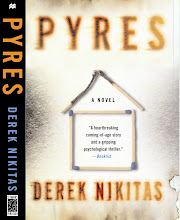
Because, you see, I've learned that one of the nominees for this year's Edgar Awards is me. Best First Novel category. And by "me" I don't mean a "medical examiner" or someone with the initials "m.e." I mean "me," the first-person objective personal pronoun. Your host.

First off, I can't fucking believe it. The Edgars are the big kahuna of mystery writing awards. This kind of stuff doesn't happen to me, but I'm sure as hell glad it did. And I got to feel that maybe something passed between Ed and me last night while I read his work, some communion. And here we are.

Ed nominated me for best first novel! All right, not Ed himself--but those folks over at Mystery Writers of America. Those kind and generous, charismatic, athletic, beautiful, genius, hilarious, affluent, sexually potent people over at Mystery Writers of America.

And my friends at Killer Year, all of whom share exactly those same superhuman characteristics as the people at MWA, have been so supportive and just as excited as me. Some of them even more excited.

I don't know if Eddie would've liked Pyres. I like to think he would've been grudgingly amused, though he would've complained that it couldn't be read in one sitting and there were too many subplots. If I could've written you a poem, Mr. Poe, I would've. But thank you, sir, thank you. You have humbled me deeply, completely.

Here's the run-down of book nominees:

Best Novel Nominees
Christine Falls by Benjamin Black (Henry Holt and Company)
Priest by Ken Bruen (St. Martin's Minotaur)
The Yiddish Policemen's Union by Michael Chabon (HarperCollins)
Soul Patch by Reed Farrel Coleman (Bleak House Books)
Down River by John Hart (St. Martin's Minotaur)

Best First Novel By An American Author Nominees
Missing Witness by Gordon Campbell (HarperCollins - William Morrow)
In the Woods by Tana French (Penguin Group - Viking)
Snitch Jacket by Christopher Goffard (The Rookery Press)
Head Games by Craig McDonald (Bleak House Books)
Pyres by Derek Nikitas (St. Martin's Minotaur)

Best Paperback Original
Queenpin by Megan Abbott (Simon & Schuster)
Blood of Paradise by David Corbett (Random House - Mortalis)
Cruel Poetry by Vicki Hendricks (Serpent's Tail)
Robbie's Wife by Russell Hill (Hard Case Crime)
Who is Conrad Hirst? by Kevin Wignall (Simon & Schuster)

Best Critical/Biographical

The Triumph of the Thriller: How Cops, Crooks and Cannibals Captured Popular Fiction by Patrick Anderson (Random House)
A Counter-History of Crime Fiction: Supernatural, Gothic, Sensational by Maurizio Ascari (Palgrave Macmillan)
Deviance in Contemporary Crime Fiction by Christiana Gregoriou (Palgrave Macmillan)
Arthur Conan Doyle: A Life in Letters by Jon Lellenberg, Daniel Stashower and Charles Foley (The Penguin Press)
Chester Gould: A Daughter's Biography of the Creator of Dick Tracy by Jean Gould O'Connell (McFarland & Company)

The awards will be announced at the MWA's 62nd Annual Edgar Awards banquet on Thursday May 1, 2008 at the Grand Hyatt Hotel in New York City.

At that banquet, Bill Pronzini, author of the "Nameless Detective" series will be honored with the 2008 Grand Master Award.

Thursday, December 27, 2007

Anatomy of Melancholy

I like a look of Agony,
Because I know it’s true—
Men do not sham Convulsion,
Nor simulate—a Throe—

The eyes glaze once—and that is Death—
Impossible to feign
The beads upon to Forehead
By homely Anguish strung.
—Emily Dickinson


I teach college. Lit, writing, movies. I don’t teach schlock, so I’ve done my fair share of defending what I teach against students who’d rather not have what I’m teaching taught to them. It doesn’t burn me out, this tireless defending. I thrive on it. I thrive because every semester a handful of students get it. As for the rest: I tried, so, hey, shove off.

I’d be here all night if I listed what sorts of arts I defend against the forces of kitsch and mediocrity. I’m not saying I don’t fall prey in my own writing. Mediocrity is seductive, especially when you’re burnt out and over deadline. I’m talking here about the books and stories and movies I teach. Students hate surrealism, for instance. When did that start?

Gen-Xers loved the surreal. We watched MTV when it still played videos, almost all surreal. We watched Ren And Stimpy. We grew up on Twin Peaks and listened to They Might Be Giants. Natural Born Killers and David Lynch movies. Maybe it’s just me and my friends I mean. Shit didn’t have to make sense. These kids, they call it “random” and dismiss it. No logical sense equals no value. One wonders what these kids think when they see SpongBob Squarepants or almost all the shows on Adult Swim. I got a lecture on the virtue of surrealism, but I’ll save it.

I’m more concerned with Melancholy. Not concerned with the word’s literal meaning, just its sense in art. Melancholy is a basic human need. A defense mechanism. In this age of self-help and The Secret, of born-again Christianity and depression medication, Melancholy is in danger of going extinct. Fine: Melancholy won’t go extinct as long as there are humans to brood, but I fear it’s losing its respect as a viable mood. Melancholy in my book: the artful shaping of depression, sadness, pessimism, loneliness, spiritual doubt and all other quietly negative moods so as to give a positive charge.

Think most of Ingmar Bergman or Lars von Trier’s films. Think Wes Anderson and Woody Allen’s brand of cinematic humor (when they’re at their best). Think P.T. Anderson in Magnolia and Punch Drunk Love. Think nearly every great writer in the history of English, but especially Thomas Hardy, Dickens at his gloomiest, Emily Dickinson and Shakespeare in his sonnets and in Hamlet. Some of the great noir writers, like Horace McCoy in They Shoot Horses, Don’t They? or Dave Goodis in Down There (i.e., Shoot the Piano Player) have built whole worlds out of Melancholy. Heck, noir’s another word for the same thing, ain’t it?

Think Edvard Munch’s or Edward Hopper’s paintings. Think all the great shoe-gazer bands of the last twenty years, like Joy Division, The Smiths, The Cure, Bright Eyes, Radiohead, Coldplay, Interpol, The Eels—too many to list.

Literary graphic novels have a corner of the Melancholy market. Ex: Jimmy Corrigan: The Smartest Kid on Earth, Persepolis, American Splendor, and Fun Home. Seems almost paradoxical, the medium made for bright flexing action heroes could be so still, silent, contemplative. But one page of Chris Ware’s work will convince you that “comic” panels were custom-made for Melancholy.

I have trouble getting students to accept that Melancholy is a beneficial emotion, that aesthetic brooding is a worthwhile pastime. But if not for Melancholy, I’d be depressed. When confronted with Melancholy, some people say, “This is depressing,” a statement meant for dismissal, for banishment. Luckily, they listen to reason if you reason well enough. Melancholy is about emotion but sometimes it takes reason to get there, a new perspective on what art is for. I’ve actually convinced people born after 1985 to enjoy Bergman’s Persona and von Trier’s Breaking the Waves.

Good Melancholic art takes the raw formless blue of depression and molds it into something beautiful. We have words for depression that imply nothingness, shapelessness: dark, gloom, dumps. But Melancholy shapes depression the way meter shapes raw language into verse, the way novels and movies shape raw experience into pleasurable structure, the way musical notes shape noise into song. In fact, Melancholy uses these very techniques to help shed light on the darkness of a foul mood.

The Dickinson poem at the start of this post. Her hymnal meter helps shape the dark sentiment, as does her unique view, the truth at which she arrives. She takes charge of ugliness and gives it beauty, tells us she “likes” a look of agony and we believe her. We like it too, when we see it through her lens. Melancholy still has the power to shock us, not with extravagance or spectacle, but with epiphany. Our dark emotions we keep private because we think they’re our personal burden, until Melancholy art holds up a mirror and calls it truth.

When Hollywood movies and pop songs and bestseller books tend to press experience into saccharine little cakes (Eat, Pray, Love, for instance), the right kind of Melancholy art is a cool blast against our overheated culture. It helps fortify us against the forces of blind conformity, blind faith, medicated numbness and cultural superficiality. What is temporarily satisfying and “escapist” has rarely ever felt authentic.

The virtue of Melancholy is not that it heals us, because we can’t be healed—not unless we want to stop feeling altogether. Melancholy teaches us how the bear the pain, how to make it drive us in our thoughts and experiences. This is what all good art does, I guess. Happy endings cheat us out of that possibility much too often.

I’ll admit Melancholy doesn’t work for everybody. Those who are truly, medically depressed have pain too strong for art to shape. Same with those who’ve seen real trauma, especially if it’s recent. On the other hand, if you’ve lived a Disney fantasy your whole life, your sense of truth will always be skewed, even a little deadened. God help you when the pain arrives. But the rest of us, I think, can benefit from a vitalizing walk in the gloaming every now and then.