If you're read my fiction, you might know I have an affinity for the band Nine Inch Nails. Have since, oh, 1992, when the EP Broken was released, and all my teen angst suddenly came blasting back at me through my earphones (never mind that the brainchild behind NIN--Trent Reznor--was 26 when he recorded that album).
Trent and I are both older now, but his deeply nihilistic worldview has always been a current conductor for the darker aspects of my creativity. You might say I learned how to do noir from Trent Reznor.
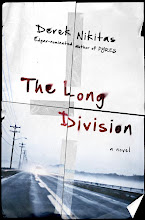
My last novel, The Long Division, in particular, references NIN lyrics on various occasions, though not for more than a word or two, owing to the fact that I can't afford copyright clearance. While I was writing Division, the NIN song "Right Where it Belongs," off the album With Teeth became the unofficial "theme song" for my character Wynn Johnston, an disturbed young man whose sense of reality is gradually cracking.
"Right Where it Belongs" is a haunting song with "Alice Through the Looking Glass" metaphysical themes regarding the "reality" of our earthy existence. It's Lewis Carroll, it's Plato's "Allegory of the Cave" or The Matrix in song form--except that the other side of Trent's looking glass isn't Wonderland or "the ideal truth," or even Neo and Orpheus and Trinity battling giant octopus robots.
It's absolute oblivion, total un-being. For me, the song derives its power from its truth value. It doesn't need to concoct a fantasy realm to scare us. It just tells us exactly what's coming, what's already there. Cheerful, huh? No--but there's a kind of melancholy satisfaction, an inner peace, that comes from pondering the unhappy truth--and this song captures it better than few I know.
Trent and I are both older now, but his deeply nihilistic worldview has always been a current conductor for the darker aspects of my creativity. You might say I learned how to do noir from Trent Reznor.
My last novel, The Long Division, in particular, references NIN lyrics on various occasions, though not for more than a word or two, owing to the fact that I can't afford copyright clearance. While I was writing Division, the NIN song "Right Where it Belongs," off the album With Teeth became the unofficial "theme song" for my character Wynn Johnston, an disturbed young man whose sense of reality is gradually cracking.
"Right Where it Belongs" is a haunting song with "Alice Through the Looking Glass" metaphysical themes regarding the "reality" of our earthy existence. It's Lewis Carroll, it's Plato's "Allegory of the Cave" or The Matrix in song form--except that the other side of Trent's looking glass isn't Wonderland or "the ideal truth," or even Neo and Orpheus and Trinity battling giant octopus robots.
It's absolute oblivion, total un-being. For me, the song derives its power from its truth value. It doesn't need to concoct a fantasy realm to scare us. It just tells us exactly what's coming, what's already there. Cheerful, huh? No--but there's a kind of melancholy satisfaction, an inner peace, that comes from pondering the unhappy truth--and this song captures it better than few I know.
As of last year, Nine Inch Nails has gone on a rather long hiatus, which is actually nothing new for Reznor, who's been known to let almost a decade pass between albums. But, actually, Reznor's output has been pretty steady in the last few years: Year Zero, Ghosts, The Slip. And even now he doesn't seem to be resting on his laurels.
Recently Rznor got married to a musician named Mariqueen Maandig, formerly of the band West India Girl. Yes, one tends to want one's mope rock heroes to avoid normal, happy things like getting married, a la Morrissey's famous musical vow: "I will live my life as I will undoubtedly die: alone." But you can't begrudge a guy a little happiness every now and then.
Especially when his marriage results in a new band and a new way to channel his creative energies. That band is How to Destroy Angels. Mariqueen sings, at least on the tracks I've heard so far. I'm a little ambivalent.
Mariqueen is a breathy, quiet singer like Charlotte Gainsbourg or that lady from Portishead. She doesn't belt it out with raw emotional energy like her husband, one of the most viscerally exciting singers of my generation, but this is more subdued music, slightly more conventional than what Trent's been doing. But it grows on me quickly.
And one certainly can't begrudge their first video. In instantly captures that noir sensibility that I've always found so captivating about Reznor. Mariqueen and Trent, both of them victims of some violent murder. It's a bit disconcerting to see the soul hero of your adolescence immolating in a pool of his own blood, but, hell, we're talking about the guy who recorded his classic album The Downward Spiral in the Tate-Polanski house. He's like that.
Recently Rznor got married to a musician named Mariqueen Maandig, formerly of the band West India Girl. Yes, one tends to want one's mope rock heroes to avoid normal, happy things like getting married, a la Morrissey's famous musical vow: "I will live my life as I will undoubtedly die: alone." But you can't begrudge a guy a little happiness every now and then.
Especially when his marriage results in a new band and a new way to channel his creative energies. That band is How to Destroy Angels. Mariqueen sings, at least on the tracks I've heard so far. I'm a little ambivalent.
Mariqueen is a breathy, quiet singer like Charlotte Gainsbourg or that lady from Portishead. She doesn't belt it out with raw emotional energy like her husband, one of the most viscerally exciting singers of my generation, but this is more subdued music, slightly more conventional than what Trent's been doing. But it grows on me quickly.
And one certainly can't begrudge their first video. In instantly captures that noir sensibility that I've always found so captivating about Reznor. Mariqueen and Trent, both of them victims of some violent murder. It's a bit disconcerting to see the soul hero of your adolescence immolating in a pool of his own blood, but, hell, we're talking about the guy who recorded his classic album The Downward Spiral in the Tate-Polanski house. He's like that.