Wednesday, August 13, 2008

Good People

So I'm being terrible at updates again. But only because I'm writing book two. And getting moved into my new house in Kentucky. And prepping for classes. And hanging out with the Chautauqua County Sheriff's Department in NY to do some serious hands-on research for the aforementioned book two.

I should mention I'll be teaching--four courses!--at the South Carolina Writer's Workshop this October. I'm psyched, particularly because Michael Connelly, one of the world's great crime writers, will be there as the keynote speaker. In honor of Mr. Connelly, two of my seminars will be focused on analyzing the structure of his two greatest novels thus far: The Poet and Bloodwork. I'm having a lot of fun reading through them again from a practitioner's and learner's POV. Nothing like a good novel read closely to teach a writer how to write. Plus I get to hang out with my St. Martin's editor, Michael Homler, do a seminar with him, and endlessly speculate with him about the upcoming G.I Joe movie.

If you're in the South Carolina area and want to spend a weekend on the beach absorbing the wit and wisdom of some great writers (and hear nonsense from me), consider signing up. Of course, if you're looking to study creative writing long term, mostly from the comfort of your own home, there's always this soon-to-be-legendary low-residency MFA program. You might recognize one of the professors...


All right. More than enough bullshit about me. Let's talk about a real writer.

Today is the day that my pal Marcus Sakey releases his third novel, Good People. His first two novels, The Blade Itself and At The City's Edge sealed his reputation and earned him mega fans and critical accolades. Hell, Ben Affleck is directing The Blade Itself as his follow-up to Gone Baby Gone. But Good People is his real masterpiece, and it's going to put him up there with the other household names in crime writing who are also quality writers and storytellers (an uncommon double-whammy): Denis Lehane, Michael Connelly and George Pelecanos, to name a few. Bank on it. And read this fucking amazing book, Good People.

Thursday, July 3, 2008

On Moral Fiction

When I watch or read the best examples of noir fiction, I'm reminded that the noir narrative is at its core a moral narrative. I don't mean that prissy, one-dimensional morality you get in "inspirational" works. I attended a book event where I was inexplicably seated next to an inspirational writer for a signing. One of her books was about a goth who, throughout the course of the book, is turned from her wicked ways toward Jesus. She asked me what kind of books I write, and I said, "noir, which is sort of the opposite of inspirational." She's lucky I didn't tell her I wrote Satanic books. I don't, not exactly--but it would've been fun to see her squirm.

My problem with prissy moralism in fiction has nothing to do with faith or lack thereof--it has to do with the unidimensional, anti-dramatic nature of moral absolutism. If there is only one way, then the reader can only respond to the narrative in the narrowest emotional sense: with smug self-righteousness. There are easy answers when there should be hard questions.

When I told the woman that noir is the opposite of inspirational writing, I was trying to be provocative. The opposite would be just as limited: nihilism, or whatever. In truth, the morality plays that the best noir stories dramatize engage in the intricacies of moral relativity. They ask questions instead of providing answers.

I recently watched Hard Candy and saw yet another example of just such a moral conundrum: what if the teenage "victim" of an internet pedophile stalker turns out to be the sadist herself, and tortures the supposed antagonist? (Granted, Hard Candy isn't as provocative as it wants to be. The pedophile is beyond sympathy, no matter how "human" and gut-wrenching his performance. Gradual revelations increasingly solidify our distaste for him, polarizing the viewers' reactions. By the time we reach the end, the question is no longer "does he deserve it?", which is the most provocative question; instead, the question is only, "is this girl a hero or a nutcase?," which is a dramatic but all too common cinematic question).

Still, the point is there. Gone Baby Gone (the film; haven't yet read the book; I know, I know) gives us a better example in its last act, one I won't spoil here. Suffice it to say that a question is asked which can never be properly answered. The viewer leaves frustrated, maybe a little angry. Richard Aleas' little masterpiece Songs of Innocence, Michael Connelly's Blood Work and the film Memento all provide moral conundrums about the circularity of crime and its investigation. You get to thinking about it, and you go around and around, and you can't get off.

Frustration, anger, moral relativity. These are the tools of noir, and that's why I think the genre is still so provocative. In fact, it's defined more by these effects than by any motif of character or plot. This is also why "noir" is a somewhat unpopular genre for mainstream readers and viewers. It's an inherently unsatisfying, anti-feel-good genre.

The producer for Hard Candy says in the extras that the job of independent filmmaking is to ask questions instead of providing answers. By contrast, Hollywood trades in Satisfaction, good old Catharsis. This view is a little too simplistic, since numerous Hollywood movies have provided provocative moral conundrums, and all too many independent films provide nothing but exploitation or candy-ass moralism.

I tell my students that (E)motional (M)anipulation of the (A)udience is the main job of the writer, but this isn't as simple as it sounds. The best manipulation is supple and subtle, complex, ironic. It isn't polarizing. Moral positions are used as tools toward that emotional response, since moral engagement is an excellent way to spark emotional responses, from smugness to outrage. So, really, I'm being a terrible moral relativist here, claiming that morality is just a device toward the exercise of EMA. Morality, in fiction, has no pure value in and of itself. It's just a dramatic tool.

We like to believe our moral positions are firm, but nearly every moral "virtue" has its equally virtuous binary opposite, and the clever and provocative writer will recognize how these oppositions can play against each other.

Your average American, for instance, is constantly being tugged between the two polar oppositions of "individual freedom" and "family obligations." We believe in both, passionately, but the one is often in opposition with the other. How many crime novels have played with the oppositions between "truth" and "justice?" LA Confidential is primarily about how justice can only be achieved if the truth is suppressed, and how powerful figures manufacture truth in order to avoid justice.

When moral oppositions come into conflict with each other, the effect is much like hot and cold weather systems clashing together. You get thunder. In fiction, that thunder is called "irony." I think we throw that word around too flippantly, and ignore its power far too often, when we're constructing plots. Irony (the thunderous collision of moral positions) is perhaps the most powerful literary device we have at our disposal.

Unlike most uses of sex and gore and profanity, irony still has the power to shock the reader or viewer. It will always have that power because of how it works: it knocks us out of comfortable moral posturing and reminds us that we're all hypocrites at heart. It holds us over the great chasm of human Mystery and reminds us not to be complacent about our beliefs.

It's not a comfortable feeling, which is why most writing-for-pure-entertainment (including most mystery novels, probably) avoids it. But it is a terribly powerful feeling, indeed.

Wednesday, July 2, 2008

Pyres in Ireland

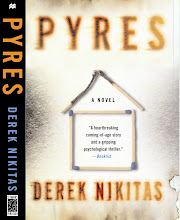
My friend and fellow writer Craig Renfroe, who gets to globe trot all around Europe this summer, has spotted a couple copies of Pyres in a bookstore in Dublin. There's no UK version of Pyres or anything; just a couple volumes of the American edition making one hell of a swim across the Atlantic. Craig has also pointed out that my posts are not tiny like I said they'd be. This was true, until now.

Saturday, June 28, 2008

Ah, Robot Love

"Some day, there will be college courses devoted to this movie"
--Lou Lumenick, New York Post

What movie? Why, Wall-E, of course. A seeminly innocuous enough film. Not much fanfare upon its release yesterday, considering it's a Disney Pixar flick, most of which seem over-promoted even before their release. In fact, I predict Wall-E won't do quite as well at the box office as its Pixar predecessors, mostly because it doesn't have the same kinetic speed, bright palate, and star voice talent. In fact it's a rather dark and somber film, for a kid's movie.

But I share Lou Lumenick's sentiment about this Masterpiece. I saw it yesterday, and already I want to teach his proposed college course about Wall-E. It is an absurdly amazing movie. Most of the major critics--Salon.com excluded--have also announced their undying love for Wall-E.

How would I teach a class about Wall-E? I'm just brainstorming here. I'd probably spend a week discussing the fundamentals of classical Hollywood storytelling, particularly the tendency for film to be a visual medium. This may seem self-evident, but it's not. If film sound had been developed at the dawn of moviemaking, the movies would be fundamentally different than they are now. Our film "language" owes a great debt to the silent era, much more than it does to theater.

No film I've seen in the last decade exhibits this truth more fundamentally as Wall-E. The actual speaking part of the film only constitute about about an eighth of its run time. The rest is dialogue-less. Certainly not silent, because the sound effects are exquisite and Oscar-worthy (all the more so because you notice them when theres no dialogue to listen to).

I'd spend probably a month of the course going over "post-Classical" "iconographic code," as described by film scholar Noel Carroll in his essay "The Future of Allusion." This is the tendency of contemporary Hollywood movies (that is, post 1960) to make allusions to other films as a shorthand to emotional impact and resonance. Wall-E doesn't need this shorthand, as its emotions are as pure an evocative as you can get, but the movie is a huge treasure trove of iconographic allusions.

This "formal" concern befits its themes, since Wall-E the robot is a collector of humankind's pop-cultural "trash." Weeks could be spent watching all the films to which Wall-E alludes--from the obvious references to Hello, Dolly to the stylistic references to Apocalyptic and Dystopian satricial sci-fi films like Aliens and Westworld. There are numerous allusions to ET and Short Circuit, not to mention Star Wars and Blade Runner and most particularly 2001: A Space Odyssey.

The science fiction angle is only the most obvious, but there are also countless allusions and inspirations drawn from the slapstick silent film comedies of Buster Keaton, Charlie Chaplin and that famous French clown whose name I forget. Wall-E himself is a direct descendant of these "sad clown" figures, right down to the design of his binocular eyes.

All this classical storytelling and allusion-making is good enough for a great film, but its ancillary to what makes Wall-E a bona-fide Masterpiece. Part of its genius is the biting satire of human (if not simply American) consumption and big business...

(side note: from a political point of view, I believe we need to be convinced through gradual changes in our culture to avoid the monsters of conspicuous consumption and big business and obesity and all that--or else we deserve to be destroyed by them. This is the basis of the American Experiment, still in progress. Satires like Wall-E sometimes help to instigate such change. What we do not need is to be forced to change by an intrusive government and its meddling policies. That is not the American Experiment. But that's beside the point here, so back to your regularly-scheduled program).

I must admit I was actually shocked at the seriously angry subtext of this film, considering it is a Disney movie (in both senses of the word--made for kids, and the product of big business). Wall-E is all the more powerful for the adult viewer because it is able to show its sharpness even within the confines--because of the confines--of a children's film.

But the satire isn't even the real masterstroke. It's the authenticity and intensity of the movie's emotional impact. I speak specifically of the romance between Eve and Wall-E, already being hailed by more than a handful of critics as one of Film's Greatest Ever. I don't think that assessment is a stretch, really. Part of this is iconographic allusion again: we see in Wall-E a bit of Chaplin's girl-wooing, the aforementioned Hello Dolly dance-courtship motif, even at least one Annie Hall moment (Wall-E the robot bears a resemblance to Woody Allen, via the sad-clown motif and the Allen-esque trope of pairing a strong, noble woman with a fussy slouch of a man).

Eve herself is firmly rooted in the tradition of badass female action heroes like Sigourney Weaver (who lends her voice to Wall-E as a Hal-like ship mainframe computer) even as she is also ET the interterrestrial horticulturist--how's that for intertextuality.

The success of a movie, on any narrative art, depends on its ability to make the audience feel by proxy the emotions the narrative is attempting to evoke, and to convince the audience that those emotions are authentic despite our absolute knowledge that they are indeed artificially manufactured. In Wall-E, the robots, by their very "nature," intensify this problem: we are being asked to feel for two pieces of metal with computer chips inside them. These pieces of metal are not particularly complex: one is a trash compactor with pincers for hands and binoculars for eyes. The other is essentially a bullet-shaped IPod. They can't really speak except to say each other's names, and even then Wall-E can't really say Eve's name correctly (which only adds to the pathos). They are merely objects, cartoon--no acting or dialogue to help us understand and empathize with them. We're not even permitted facial expressions, except the most rudimentary kind.

And yet--and yet--their romance is deeply moving. I'd have to go on for pages, and think a lot more about it, in order to explain why--but the trick is all action. The purest form of visual storytelling, and by God it works. I won't belabor the point, but all of us who are involved in the narrative arts ought to closely analyze this supposed kid's movie in order to understand the mechanics of (E)motional (M)anipulation of the (A)udience, our bread-and-butter and our salvation, no matter how much we want to talk about big ideas, lyrical language, and the like. All these secondary issues work at the service of EMA. The scene with Eve inside Wall-E's trailer/home is worth a few class meeting all by itself.

One of the hardest lessons to teach budding narrative artists is how to evoke emotion with the illusion of authenticity without resorting to sentimentality or obviousness. Of course, it's also the most fundamental skill to get right. There are numerous ways: you can announce the emotion outright ("he was pissed"), also known as "telling." This is the bad way, since it's too forced, and the audience will probably resist. Another way is to use subtext, which works, though it depends on dialogue and the keenness of th audience's analytical abilities. Yet another way is to use gesture and expression ("he narrowed his eyes"), which is pretty much as bad as telling--mainly because almost all gestures and expressions have become cliche, and if they're pushed too hard they can quickly get melodramatic, operatic.

Finally, you have action--the purest and most effective of all. Action doesn't tell, but it insinuates. Actions can be unique, and sometimes even profound. I could go on about this, but I'd rather just say:

go watch Wall-E, and see for yourself.

Monday, June 23, 2008

Truth and Death

Saturday, June 21, 2008

This is the Crisis I Knew Had To Come

This week, finally got to see the Ian Curtis bio-pic, Control.

Wanted to see this movie in the theater, but rarely get out to the theater, except to see special effects extravaganzas that won't look good on my dinky TV when they hit DVD,. Or to see kid's flicks. So in the last couple months it's been just Iron Man and Kung Fu Panda, both pretty good in their own rights.

The Panda movie's got some great visuals and funny shit, but the storyline was pretty rote. Iron Man was great until the "action packed climax," the same point where nearly all superhero movies fall flat. It's the same fight over and over. No divergence from the script. I don't know why people keep wanting to see the hero and the villain bash into each other for fifteen minutes.

These scenes need more cleverness, more intrigue--less brute force. From the previews, The Incredible Hulk looks to be the same deal, just as Ang Lee's (underrated) The Hulk was. Yes, underrated. What Lee did with mimicking comic-book panels and with Bruce Banner's inner turmoil was sharp. What ruins the movie is the dull climax and the crap special effects--really, everything about the Hulk himself, which is certainly a problem.

Downey Jr. made a great Iron Man. I just wanted to be the millionth person to say it. Round the same time I saw Iron Man, I saw another Downey Jr. movie I'd been hearing too much buzz about to ignore--Kiss Kiss, Bang Bang. I don't know how this one slipped by me when it first came out. The dialogue was hilarious, not to mention the monologues. Like the best postmodern treatments, the movie plays as a kind of parody of the detective film, but also runs with the best as a legitimate detective film. Goes right alongside Brick for kick-ass dialogue, though nothing tops Closer in that particular category.

Now, Control. I'm an unabashed devotee of Joy Division, like every goth-at-heart. I buy into the whole enigma. I loved the movie 24 Hour Party People for its treatment of the early 80s Manchester, UK music scene, though I was pissed at its flippant, dismissive treatment of Ian Curtis. Yes, New Order has some good songs, but to give Joy Division's leftovers more clout than Joy Division is near sacrilegious. You see how keyed-up about this I am?

So Control gives us the full effect of Ian Curtis, every personality nuance, every facial tick, every drop of pathos. The gorgeous black-and-white cinematography captures his essence the same way Anton Corbjin, the director, captured Ian in photographs thirty years ago. You can see the devotion to character in the film, sometimes at the expense of story (that is, I'd like to have seen more about Joy Division itself, their rise, etc.; you wouldn't know from the film that the band was even ever famous).

As you might guess, the movie ends abruptly at Ian's death, which is treated with such a mixture of delicacy and rawness that I'm still in awe of it, even having known beforehand exactly how and when the man's life ends up. Yeah, I'd like to have seen more of what happened after he died, but you get that in Party People. Together the two movies, so different in tone, would make an excellent double-header--a more thorough exploration of the band (and what came afterward).

Supposedly the movie is based on Ian's wife's book about their relationship, so obviously a lot of the focus is on her character and their marital turmoil. This is as it should be, though I'm not sure Ian would've fared differently if he'd not married Debbie. He was a tragic figure to begin with, at least in my own mythic version of his life. I hate to say it, but there was a sort of aesthetic dignity, a fruition, in his death, that gave his music its power: "this is the crisis I knew had to come/destroying the balance I've kept" ("Passover"). That's like the mantra for every tragic hero in lit history, all the way back to Oedipus.

Yeah, I'm always on about not taking an artist's bio into consideration when judging the work, but Ian is an exception. He was a sacrifice to art, plain and simple. It's sick to think this way, to justify a suicide or untimely death--but isn't art sometimes bigger, more important, than the mortality of the person who creates it? Would we care so much about The Doors, Jeff Buckley?

Everybody wants to go see Heath's Joker next month because Heath is dead, and frankly it's going to add a dimension to the role. I've even heard suggestions that the Joker killed Heath, the psychological strain of playing him. Sounds like a stretch to me--we're talking about a comic book character, folks--but you never know.

Be honest: how many of you writers out there wouldn't sacrifice your very life if it meant the sacrifice would allow you to write one of the ten greatest novels of the 21st Century? I'm not trying to be morose, really. Death is a cosmic travesty, every. single. time. (but then travesty is pathos!)

I really don't know how I would answer the question, but then I don't have the terminal gift that Ian Curtis had, so I don't need to fret about it. I'll let my characters live out that fatalistic fantasy. That's noir, after all. Still, people justify sacrifices for nations and religions all the time, so why not art?

Friday, June 20, 2008

Tiny Posts

So I haven't posted in--yikes. Been working on getting novel two done by summer's end, turning it over to my amazingly patient editor at St. Martin's. The bigger reason for no posts is this: I tend to write full-fledged essays that drain all my writing energy. So, the solution: more updates and posts will mean smaller posts. Maybe the occasional 1000-word outburst, but mostly little bitty ones. So here's the news lately:

I'm finally going to get to be what I've been working toward for too many years. Only my quest to be an Author has gone on longer. In two months, I begin my first tenure-track gig as a creative writing professor at Eastern Kentucky University. It's been a long haul toward this day, and I'm glad to be settling down with EKU and in a small city called Richmond, 2o miles south of Lexington, Kentucky. It's no Atlanta, but I won't miss the traffic and the heat. Plus, there's always Lexington when I get a hankering for big city life.

EKU has just started a low-residency MFA program for creative writing, and I know it's going to be a monster success. They've hired three new writers--myself, Julie Hensley and R. Dean Johnson--to join stellar poet Young Smith in this new program. Not everybody's down with the idea of trucking off to school to learn to write for a stretch of years, so low-res might be the answer (if you choose to go the MFA route at all). EKU's program is particularly affordable, and you can do almost the whole thing from the comfort of your own home. Plus, you'll get a chance to imbibe the wit and wisdom of my colleagues and myself. Just saying.

Bought my first house--an older, but spacious (five bedroom) crib overlooking a beautiful rolling hill. It's even got one of those ubiquitous Kentucky horse fences in the backyard, though no horses. My favorite parts of the house are the wet bar in the living room and the office in the garage, perfect to set up shop for writing. Luckily, the wet bar in not in the office. That, as you know, is an occupational hazard for writers. Home ownership's no picnic, but I've been renting for fourteen years, and this is long past due.

I'm also thrilled to report that this week I joined the ranks of a few dozen talented and lucky-ass writers who are represented by super-agent David Hale Smith of DHS Literary. Friends kept recommending him, I sent him my stuff, he claims he loved it, and the rest is history. His clients and my pals Theresa Schwegel, Duane Swierczynski (some day I'll learn to spell that without having to look it up), and J.D. Rhoades can't say enough good things about him, so I'm happy to join the party.

David is also the agent for the elusive and massively talent writer Boston Teran, whom I've never met or even seen a picture of. Frankly, I'm skeptical he exists, though somebody wrote an unbelievably dark and compelling novel called God is a Bullet under his name (not to mention three other novels). I picked it up after a few readers compared my Pyres to that novel, and I must say the comparison is much too kind to my book. More on that some other day.

God is a Bullet
will apparently be a movie next year, directed by Nick Cassavetes, son of one of my favorite directors of all time, John Cassavetes. I have to admit I've not been a huge fan of Nick's work as of yet (i.e. The Notebook), but he's also not trying to be his dad by any stretch of the imagination. He's rumored to be directed the upcoming Captain America feature, for goodness sakes. At any rate, I hope Nick will find a way to do justice to Teran's brilliant material.