Monday, January 25, 2010

Interview with Art Taylor

Here's an interview with Art Taylor just posted today at "Art and Literature." Taylor is a great fiction writer in his own right, but also a critic and professor of English and George Mason University. I was delighted to the a subject of one of his interviews, as I've read several of his previous interviews with interest, especially the one with James Ellroy.

Here's a quick preview of one q and a, the controversial question of "genre" fiction in the academy. I had to restrain myself, as I had much more to say on the subject:

TAYLOR: You earned an MFA from UNC-Wilmington and are pursuing a PhD at Georgia State. My impression has been that many (perhaps most) such grad school programs see a significant divide between so-called literary fiction on the one hand and genre fiction on the other and may tend to stigmatize or even dismiss the latter — and when you yourself go from crime fiction to zombies, you may really be riling the ranks. What was your experience as a “genre writer” in MFA workshops and in your current program? How have those experiences deterred or enhanced your work? And I have to ask, given how much effort you’re devoting to your fiction, how are you finding time to pursue a PhD (and why are you pursuing one at all)?

NIKITAS: I agree that formulaic writing is often disappointing because it engages the reader only on one, too-comfortably-familiar level. But “literary fiction” is a genre, or a catchall for a group of genres like magical realism, domestic realism, southern gothic, minimalism, etc. It has tropes, just tropes that are different from the mystery, or sci-fi, or whatever. Equally as much “literary fiction” is formulaic, like the formula for the “Chekhovian story” (aka, the “MFA” story).

A resourceful writer will use whatever tools he’s got available to enhance a reader’s interest in his fiction, whether those tools are poetic lyricism, an unreliable narrator, or rotting zombies. Many student writers will want to entertain via genre tropes, not because they want to be more marketable or write more “easily,” but because they’re genuinely drawn to these types of stories. (I’m inclined to believe the anecdotal evidence that this is partly a class issue — related to what forms of entertainment we were exposed to in our formative years — a possibility that makes me all the more sensitive to it.)

A conscientious teacher of writing should recognize and champion all of the above. We can’t all be Chekhovians, though some of us want to be Chekhovians, and should be encouraged to follow in his footsteps as we explode the formulas that have been extrapolated from his work.

I want to tell the haters to look around. The Modernist divide is largely gone. We’ve cross-fertilized. Cormac McCarthy, Michael Chabon, Jonathan Lethem, Kelly Link, Karen Russell, Joyce Carol Oates, Toni Morrison, Justin Cronin, Junot Diaz. How many current, big-name award winners do we need to name before we concede that the genre tropes of ghost stories, adventure stories, crime stories, vampire stories, fairy tales, gothics, superhero stories, dystopias, and fantasies are flourishing in literary fiction?

I was lucky to work with faculty at UNC Wilmington who encouraged my writing experiments no matter where those experiments took me. Wilmington is where I took classes that introduced me to classic hardboiled crime and the great genre films of the ’60s and ’70s. Wilmington’s where I learned to write novels that consider their audiences and seek to entertain. It’s where I learned that good plotting is the hardest element of the craft and is not a cop out. It’s also where I learned that subtlety and originality of expression and characterization can push good work to the next level of quality.

I know my “genre tendencies” quietly disqualify me from certain opportunities, but they’ve also opened some doors, not the least of which is a modest but actual readership. I’m invigorated knowing that my writing is faithful to my own readerly interests. I’m also deeply satisfied to know that, as a teacher, I add a new flavor to the mix. My students hear a variety of advice from my colleagues and me, some of it contradictory, oh my! Our students must think deeply without passive acceptance. They must experiment and evolve and follow the advice that serves them best for the project at hand. Isn’t that how it should be?

Saturday, January 16, 2010

My Zombie Story--Free

So here's a sexy e-card to publicize St. Martin's forthcoming zombie short story anthology, with pieces from many famous authors, and me. But you don't have to wait another month to read my story! Oh, no! If you follow this link, you can get access to a couple stories from the antho for free, including mine. It's called "My Dolly."

I'm excited to be a small part of this swarm of undead and unleashed, the legions plagued with the "flesh the grave cave ate," as Sylvia Plath wrote. I can get even more highbrow and dig out some of my favorite zombie poems from Tom Hardy. Just watch me!

The New Dead is already getting some enthusiastic press, including a starred review from Publishers Weekly:

The New Dead Edited by Christopher Golden. St. Martin’s Griffin, $14.99 paper (400p) ISBN 978-0-312-55971-7
The 19 provocative, haunting, and genuinely unsettling original stories in this zombie anthology move the genre beyond its usual apocalyptic wastelands. David Liss’s novelette “What Maisie Knew” is a stunning and gruesome meditation on the banality of capitalism and evil. Mike Carey’s “Second Wind” is a haunting tale of an undead stockbroker who comes to question whether he ever truly lived. Lovers of more traditional zombie fare will also not be disappointed. Joe Hill’s ingenious “Twittering from the Circus of the Dead” tells a classic slasher film story through Twitter posts, while Jonathan Maberry’s heartbreaking “Family Business” describes a ruined America populated by kindly monks and zombie hunters. This powerful anthology shines a bright and unflinching light on the fears of death, decay, and loss that underpin America’s longstanding obsession with the undead. (Feb.)

Saturday, December 19, 2009

The Washington Post Review

For Christmas this year, I get what is quite possibly the most complimentary, most insightful review of my work ever committed to print, in the Washington Post today. Thank you, Daniel Mallory.

It begins:

"Here is a book to scorch the heart and freeze the blood. Here is a story that leaves the reader gasping in shock and sadness, dry-mouthed and damp-eyed, dragging in air as the final chapters detonate. Here, in abundance, is live-wire language pumping beauty, desire and violence like electric currents; here are characters so exquisitely textured, the pages nearly shudder with their breath."

The rest is here.

Tuesday, November 24, 2009

The Reviews Are In...

...with more to come...

The New York Times Book Review:

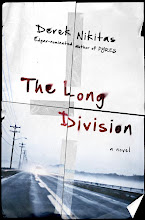
With The Long Division, Derek Nikitas bumps up the style requirements for writing crime fiction another notch. When Jodie Larkin steals $5,000 from a home she cleans for an Atlanta housekeeping service and takes off in a stolen car to reconcile with the son she abandoned 15 years earlier, she sets in motion a chain of events that will eventually unite a group of strangers in grief. That takes some dazzling plot maneuvers, but Nikitas interlocks his fragmented story pieces in a way that makes everything seem inevitable - even the murders.

***

The Onion (A.V. Club)

Though ostensibly a crime novel—complete with shootouts, plot twists, and recriminations—Derek Nikitas’ The Long Division is more a work of literary fiction than a genre exercise. Nikitas shows an interest in language and form that outpaces most other authors who write about murder, and it manifests in passages that express the characters’ internal lives in terms of what they see around them. The Long Division is never hard to follow—and it’s peppered with memorable descriptions...

... The Long Division is much better—superior, even—when Nikitas is getting inside each character’s paranoia, exploring how varying degrees of guilt lead them to believe that everyone can see how pathetic they are. That core of emotional understanding is what makes Nikitas a special kind of crime writer.

***

The Atlanta Journal-Constitution:

[The Long Division] is no James Patterson/Faye Kellerman/Dan Brown whodunit. This is a novel concerned with bigger questions of identity, forgiveness, sin and fate.... Not one of the central characters in "Division" is a bad person, and so we keep hoping they will find a way out.But Nikitas tightens the noose, then tightens some more....

[Readers] may also find that the book reminds them a little of a David Lynch movie, or Darren Aronofsky's "Pi"....

[Readers] will certainly find themselves thinking of Lewis Carroll's " Alice in Wonderland." In the book's final moments....Nikitas conjures another writer, the great William Shakespeare, who never let his tragic heroes escape their mistakes, even when their intentions were good.

***

The Charlotte Observer:

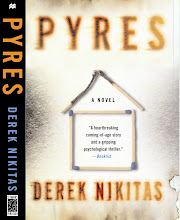
The first chapter of "The Long Division" had me e-mailing to ask the publisher for a copy of Derek Nikitas' first novel, "Pyres," which I'm about halfway through now. Both are wonderfully character-driven stories of lives gone off the rails, with special attention to teens trying to make sense of the strange world their parents have twisted like a balloon animal before handing over to them.

***

South Florida Sun-Sentinel:

In his second novel, Derek Nikitas proves that he doesn't write conventional crime fiction; nor does he write conventionally. [The Long Division] has a frenetic pacing that never lets up. Sentences break off in the middle, sometimes even in the middle of a word. Chapters skid from one character to the other. Far from being precious, this gimmick works in a cinematic way, as if The Long Division is the literary complement to Quentin Tarantino in his Reservoir Dogs/Pulp Fiction days, but with far less violence....

The author makes us care about each of these sad, lonely people who seem unable to help themselves. As Nikitas pulls these characters together, surprises pop up on the route to a finale that is heartbreaking.

***

Wilmington Star News:

Clyde Edgerton likes to quote the adage that Evil is boring; it’s Sin that’s really interesting. What makes otherwise good, well-meaning people take a detour, turn left instead of right and veer off on a path that leads to destruction? That might be the theme of “The Long Division....”

Few of the protagonists in this equation are truly evil, but, when they come together, the result is a wreck of bloody and epic proportions....

Don’t pick up this book, though, expecting another James Patterson or even a Jim Thompson. Nikitas writes in a modified stream-of-consciousness, and his characters – especially the brilliant but troubled Wynn – tend to telegraph their thoughts in a language that’s more poetry slam than standard English....

In other words, “The Long Division” is not a beach read. It’s more like introductory calculus. Those readers willing to put forth a little effort, though, will be rewarded for their pains.

***

Publishers Weekly *starred review*:

"Beautifully realized characterizations power complex story lines that meet and connect this disparate group with the inevitability of Greek tragedy."

***

Library Journal *starred review*:

Nikitas is a master craftsman of both plot and prose, merging gritty, evocative description with sharply drawn characters in a staccato style"

***

Kirkus Reviews:

"An elegantly written second novel"

Friday, November 6, 2009

Tuesday, October 6, 2009

False Dichotomies: Plot vs. Lyricism (part 2)

So what do we really mean when we say we love lyrical novels for the language? We mean we love what the language evokes through denotation. Above all, we love vivid sensory detail because we can evoke in our mind's eye a moving picture of what the words represent. When we imaginatively move the stimulus away from language, away from arbitrary sound and printed letters on a page, when we move toward the thoroughly concrete sensory evocation--this is when we move toward a true experience worthy of the effort of reading fiction.

Take this bit from Jeffrey Eugenidies' The Virgin Suicides: "He came back to us with stories of bedrooms filled with crumpled panties, of stuffed animals hugged to death by the passion of the girls, of a crucifix draped with a brassiere, of gauzy chambers of canopied beds, and of the effluvia of so many young girls becoming women together in the same cramped space."

Certainly there are aural pleasure to be taken from this passage, pure sound delights: the suggestive verbs "filled," "stuffed," "hugged," "draped." The onomatopoetic cramped sound of "cramped." The breathless nature of the syntax--exactly how we'd expect the story teller to be telling the story of his illicit foray into the Lisbon girls' bedroom. The weird consonance between "crucifix" and "brassiere."

But all of these are secondary delights, something that registers with the reader on a fleeting, half-conscious level. Nobody except an analyst stops and notes consonance. And nobody sane takes delight in the mere presence of consonance, as if the repetition of consonant sounds moves him emotionally in some way. All these effects are of note because they relate to the context--to the story and what we're to draw from it. And that's not for the sake of "the language." That's for the sake of the story.

The primary pleasure of this passage is the sensory detail it provokes, the textures and the nostalgia regarding unfulfilled teenage hormonal fantasies. "...[T]he gauzy chamber of canopied beds" sounds good, but much more importantly it looks good in the mind's eye. We can see the numerous beds, all chambered off in different compartments by the canopies, but see-through, suffused with light from a window and gently floating, all evoking senses of intimacy and secrecy, yet ironically in a shared space. We enjoy what we see on a much deeper level than what we read.

And part of the reason we enjoy it so deeply is because we, the readers, are each participating in the creation of the sensory experience. The expert author has given us cues we'll use to develop the image, but ultimately the image belongs to us. It is an act of pure imagination so separated from language that it feels like liberation from some kind of tyranny, some semiotic anchor. If the words themselves give us any aural pleasure at all, it is usually an effect that serves to accompany the imagery we're developing in our minds.

We might hear the sounds that the various fabrics make when they're touched or when they flutter, and we might even hear them in the sounds of the words themselves ("effluvia," "gauzy chambers"). But sound has everything to do with enhancing the imagined sensory experience, and little to do with some kind of love for the words themselves, detached from context. (to be continued)

Monday, October 5, 2009

False Dichotomies: Plot vs. Lyricism (part one)

Some readers like relatively plot-light, lyrical novels. They are often forced to defend their taste against the backlash: boring, self-indulgent, too distracting from the "story." A common defense: "I read it for the language."

How I wish apologists of lyrical fiction would stop saying "I read it for the language." It ain't helping the cause. Why? Because people don't really know what "for language" means. Especially those who say it. Which makes the idea too easy to dismiss as elitist or pedantic.

Come on: nobody reads novels for the language. That's like saying you eat at fancy restaurants for the calories or look at paintings for the paint. Written language is just utterances, denoted by letters, formed into words printed on a page. Yes, there's a certain musicality in well-formed utterances, but that musicality isn't the bottom-line reason we read novels, no more than the pleasantly musty smell of library books is the reason. Who would read novel after novel by the same author only because he likes the way the author makes noises?

Language poets write a kind of verbal poem that lacks any semantic meaning. Language poetry is largely performative and mercifully short in duration, and almost nobody gives a damn about it, except perhaps truly pretentious people. If you're truly in that camp, then congratulations for existing in a higher state of consciousness and aesthetic sensitivity than the rest of us philistines.

But I'll assume most of us, including those who claim to love language, aren't that detached. Even the briefest, most lyrically rich poem we read for more than mere language. And a whole novel? Come on.

So what do we really mean when we say we love lyrical novels for the language? (to be continued)