Tuesday, April 22, 2008

What The Hell Is A Literary Thriller, Anyway?

New post by me on this topic, over at Murderati. Accompanied by a frighteningly large photograph of yours truly, just for shock value.

I'd also like to encourage anyone and everyone to pick up a copy of my good friend Andrew Foster Altschul's book, Lady Lazarus. It's an epic literary fictional biography monstrosity (almost 600 pp!) full of poetry and footnotes and meta--on the subject of one Calliope Bird Morath, celebrity-poet daughter of a famed punk rock star suicide, an exploration of the culture of fame in music, Hollywood, etc. I've not yet read the whole book, but I've heard the first chapter read by the author, and it's worth the price of admission alone. This dude can spin a brilliant scene of domestic turmoil under the watchful eye of the paparazzi. I've got a copy waiting on my bookshelf for the semester to end, then I dive in. You should, too.

Meanwhile, my buddy Craig Renfroe (we've been pals ten years now, since our days in the MFA program at UNCW) has been publishing uniquely clever and concentrated shorts all over the internet. Here's his most recent one called "Trash" at The Potomac. And here's "Melvin Blaylock Attempts a Hallucinatory Revelation" from Monkeybicycle. And perhaps most enviably, here's "The Focus Group's Transcript For My Prospective Garage Sale" on fucking McSweeny's Internet Tendency! Jesus, Craig--your titles are longer than the accompanying text.

Finally, here's a little music from Andrew Bird, live on Letterman. I'm currently obsessed with this musician, this virtuoso violinist, whistler, singer, songwriter. His album Andrew Bird and the Mysterious Production of Eggs is one of the most brilliantly sustained albums I've ever heard, and I hear a lot of albums. Not a less-than-genius song on the whole thing. It has essentially supplanted every other CD in my car for over a month now, and I still can't get enough. Thanks to Danielle for bringing Mr. Bird to my attention, quite insistently, I might add.


Tuesday, April 8, 2008

Murderati Today

It's been a long while, I know, but I've been busy in the writing and teaching trenches. Three weeks from now the schedule opens a bit, semester end. Till then, here's a piece I wrote for Murderati, posted today.

Friday, March 14, 2008

Slow Dumb Show For You

My friend Ryan introduced me to The National. I'm acclimating myself to their album Boxer, and loving it more each time I hear it, despite the singer's tendency to repeat lines in order to avoid making a rhyme (a pop-song shortcut that always irks me). The song "Slow Show" is probably the best on an album of solid songs. Even though the singer, Matt Berninger, has this menacing baritone voice, this song is wistfully sweet, even romantic. With the baritone voice and heavy base, they manage a balanced amalgam of goth and folk I haven't quite heard since The Sisters of Mercy.

Below is a video for "Slow Show" I found on YouTube. It's a fan video, not official, but I like it anyway because it combines two things I love: the song and French New Wave. Yes, I know I'm only admitting my stereotypically pretentious white-boy hipsterism when I mention French New Wave, but fuck it. And praise Netflix for opening this world to me. It has enriched my life, all right?

The movie clips shown here are from Jean-Luc Godard's Masculine/Feminine, starring Chantal Goya and Jean-Pierre Leaud. Here Goya plays a role usually reserved for Anna Karina, who was a frequent Godard collaborator (and once his wife). Even from these short clips you can see why Godard liked to work with these women: Goya's a work of art all to herself, in that essentially French manner. It is true that Godard tended to visually objectify, dwelling on them with long close ups just because they looked compelling enough to sustain it, but he also made these women the center of his films, gave them complex and compelling characters.

The guy who appears in these clips is, again, actor Jean-Pierre Leaud, best known for playing the little boy Antoine Doinel in Francois Truffaut's The 400 Blows, perhaps the masterpiece of the French New Wave movement. For years I made my undergrad students at SUNY Brockport watch this movie, and more than a few times I think their eyes were opened to what depth of feeling cinema could achieve, but rarely does. Either that, or they were humoring me.

French New Wave was the cinematic "punk" movement of the 1960s. It rebelled against French films that were too bourgeois, too carefully made and pretentious and distant. French New Wave movies were often technically shoddy (though their "mistakes" became techniques appropriated by filmmakers to this day) but passionate and intimate, particularly those by Godard and Truffaut (in the 60s and early 70s). Godard has a tendency to be cold sometimes, but not in Masculine/Feminine, A Band of Outsiders, A Woman is A Woman, or My Life to Live, my favorites of his.


Sunday, March 9, 2008

Sunday Morning Reading

For your reading pleasure, here's a little profile of yours truly by Ben Steelman of the Wilmington Star News, published today. Wilmington, NC--or more specifically, UNC-Wilmington, is where I got my MFA in Creative Writing. The program was fantastic when I was there, and it has grown tremendously in size, prestige and opportunity since then.

For your listening pleasure, jump on over to Besnyo's MySpace page and listen to a few tracks from their album forthcoming on April 25th. Besnyo is a post-punk/electronic/experimental band out of Buffalo NY, a group of young guys trying to make a name for themselves in the ever-evolving music industry. Their first album was a treat, but this one shows some incredible technical and songwriting progress. Check out "Olympic" in particular, and "Promises" also in particular. Then show 'em some love and tell 'em I sent you.

Oh, it also just so happens that my little brother Steve is a guitarist/keyboardist for the band.

Wednesday, March 5, 2008

Hate On His Left Hand, Love On His Right

Hate:
1. Makers of Hollywood crime films who insist upon one-dimensional female characters. I’m not out for any political agenda. I just want to see well-developed, complex characters in the movies I watch. Most action movies, everybody’s one-dimensional. But the crime genre since the 1970s has had a kind of “literary” air—the characters are supposed to be tortured, torn, morally ambivalent. But it’s almost always the male characters. My one complaint about Scorsese’s masterpiece The Departed? The only important female character is a bore. She’s furniture. I’m on this rant because I just watched We Own The Night, saw the same phenomenon. Eva Mendez “plays” Amanda Juarez, which means she sits in Joaquin Phoenix’s lap and kisses him loudly on the mouth. Often. Oh, and she goes to visit her mother when she’s supposed to be on police protection. Big twist!
It just irks me that writers with the talent to create the most emotionally gut-wrenching male characters in crime films just fall apart when they’re asked to project, even a little bit, into a female character. Are we males that clueless? I understand crime movies are traditionally about men because men traditionally perpetrate and investigate crimes, but it’s 2008 and women can be just as morally elusive. Maybe it’s the old crime archetypes that hold women back: they’re either the Femme Fatale or the Girl Friday. But we’ve got to break out of those molds.
Even Gone Baby Gone, an otherwise excellent movie, gives Michelle Monaghan (as Angie Gennaro) almost nothing to do. She broods, and then she broods. She does two important things in the movie, but neither one of those things is particularly motivated, based on the little we know about her character. She’s a step in the right direction, sure, and the sad part is that nearly all the scenes left on the cutting room floor (or the DVD archives) are scenes that develop her character. So the depth was there in the first place—it’s just that Affleck decided to cut it out. Still, Affleck deserves much credit for what he and Amy Ryan did with the character Helene McCready. That’s a complicated woman worthy of an Oscar-nominated performance.
2. Greeters. Every damn time I walk into the store I get a fake-enthusiastic “hello there!” from an employee who obviously couldn’t give a crap about me. It happens in Blockbuster all the time, and I feel required to say hello back so I don’t look like an asshole. But I don’t want to say hello, and I don’t want to be greeted. If I wanted to be greeted, I’d come over and say hello myself, which I will not, because I do not want to talk to you. I want to rent a movie.
Who’s idea is this? Obviously company big-wigs make these decisions and pass them down to managers who pass them down to the rank-and-file employees. “You gotta say hi to everybody who walks through that door.” Do customers honest-to-God like this kind of shit? I mean, maybe I’m just a misanthrope, but I’ve never wanted all retail and food service to become like Disney World. You got to Disney World, you pay extra, to feel like you’re in a fantasy land where everybody is happy and friendly. Are we so fucking deluded to think that there’s even a scrap of authenticity in a minimum-wage-teenage-employee’s enthusiastic greeting? Please.
It seems to be getting worse. I go to Moe’s (a chain Mexican fast food store here in Atlanta) because I like their fish tacos. I don’t go there because I like what happens when I walk in the door, which is that everyone stops what he’s doing and yells “Welcome to Moe’s!” like a football coach telling you to go run laps. It’s so contrived, I almost lose my appetite. Is there one person, just one person on this entire planet except the dumbass who came up with the idea, who likes to be party to this kind of behavior? Or worse: I went to Joe’s Crab Shack last weekend and witnessed an entire squadron of waitresses forced to gather together and dance to that stupid disco song about a carwash. They did the Electric Slide (or some-such dance) right there in the restaurant, whooping along at the appropriate parts. Are these waitresses or performing monkeys? I was not amused. I could tell the waitresses were not particularly amused. I was deeply, deeply embarrassed for them, and I just wanted to eat my crab legs in peace. Only a total asswipe would be amused by that.
Love:
1. Trent Reznor, even after all these years. I’ve been a Nine Inch Nails fan since Pretty Hate Machine, even over those long years of silence between albums. Yes, I’ll admit that some of Trent’s charm has faded now that I’m in my thirties and his teenage angst lyrics don’t quite hit me in the way they used to. And, yes, I’ll admit he’s stagnated a little bit since The Fragile and his best work is probably behind him. But even after all these years the guy’s got the verve to kick the music industry where it hurts the most.
Three days ago Nine Inch Nails released their new album. Even the most hardcore fans—and there are millions around the world, mind you—had absolutely no idea a new Nine Inch Nails album was on its way until the moment it dropped. There were little clues like the cryptic “two weeks” posted two weeks ago on the official website, but no media, no leaks, nothing. Just Sunday morning Trent says, here you go: Ghosts I-IV. It’s 36 new songs. Thirty-six. Almost two hours of new music. Not remixes, new music. The man is beautifully insane. Yes, it’s all instrumentals and some of it is very ambient and minimalist (some may read this as “boring”), but it’s still a major NIN release with absolutely no buzz about its release.
What’s better, the music is only available online right now, and it costs five bucks. For thirty-six songs. Since Trent is now totally unconnected to a record company, he can still make some nice dough releasing his own stuff for five bucks, cutting out the middleman who takes most of the proceeds anyhow.
Because of its experimental peculiarities, Ghosts I-IV isn’t for everybody, even some longtime NIN fans. Even I have to admit some patches of it are underdeveloped and should probably have been left out, but I’m just glad I have a bunch of good instrumental pieces I can listen to while I write. I can’t listen to music with English lyrics while I write, so I’ve been looking for instrumental or foreign-language stuff that fits my writing mood. This’ll do it. The Sigur Ros albums were getting kind of worn, anyhow.
2. Timothy Hallinan, author of A Nail Through the Heart, for letting Pyres grow on him.
Indifference:
The blog “Stuff White People Like.” An ongoing list of, well, you get the idea. I am profoundly amused by the writer’s uncanny ability to convince me that I am indeed a white person, through and through. On the other hand, I am horrified to learn that I am essentially a parody of myself. Look back over my blog entries and you will find that when I am being my most earnest, I am a joke, because I am exactly like all other white people (well, “progressive” young white people). I am a stereotype. Thanks, man. ‘Preciate it.

Saturday, March 1, 2008

Turning Japanese

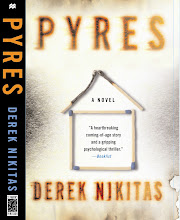
My novel Pyres has been purchased by Hayakawa Publishing for translation and publication in Japan! Forgive my excitement, but this is my first translation sale ever. Now my bio can say "Derek Nikitas's work has been translated into one language!" But seriously, all you Japanese fans clamoring to get a hold of a translated version of Pyres shall wait no longer. Not that I've ever heard from a Japanese fan. And not that the book is being published right now. In fact, I don't even know when it's going to come out. Still I can't wait to get my very own copy, full of...

(okay, I was about to write "pictographs," but not wanting to look like an idiot (too late), I did five minutes of research. Turns out Japanese characters are not "pictographs" (pictures that are meant to represent exactly what they picture), nor are they "ideograms" or "logograms" like in some Chinese characters (symbols that represent complete ideas rather than mere sounds like in the English alphabet; our numerals are ideograms, like 1). Anyway, modern Japanese is phonetic (sound based) just like English. The "lettering" is called hiragana, or katakana. There is an element of the Japanese writing system called kanji, which is apparently ideographic, because it is older and borrowed from China. Feel free to correct me if I am wrong about this information. Either one of you.)

I can't wait to get my very of own copy of the Japanese edition full of Japanese hiragana and katakana that I can't read. It'll be fun to look at and to break out at parties, nonetheless.

Friday, February 29, 2008

Can You Do a .357 With a Bayonet?

I don’t go to the movies much. Even when it’s something I desperately want to see. Can’t justify the cost. Only P.T. Anderson and the Coen Brothers have lured me to the theater this year—There Will Be Blood and No Country For Old Men, respectively. Both fantastic films, the latter being the clear victor, as the Academy rightly noted last week. I loved There Will Be Blood, no question. I especially like that PT pulled off what I thought impossible: making oil prospecting interesting. But there were a few slow moments, and the end—well, another risky ending on PTs part that doesn’t quite come off as brilliantly as the frog rain in Magnolia. The end of There Will Be Blood felt too much like a punchline to something I didn’t think was a joke. “I’m finished.” Ha, ha, Plainview. You’re a riot.

Rent a lot of movies. Finally got to see The Darjeeling Limited this week. Been eager for that one for a while, being as I’m a huge fan of Wes Anderson, no relation to PT. His breakthrough movie Rushmore hit me at just the right moment in life—early in grad school, nostalgic for a high school life I didn’t actually lead. Max Fisher spoke to me, and I thought Anderson’s deadpan humor, mostly derived from camera movement and elaborate mise-en-scene was brilliant. Some people don’t get it at all, and I can hardly explain why. Anderson is one of the few, if only, directors who can make a camera movement funny. Sure, he borrows nearly all his techniques from French New Wave, but the French New Wave guys are dead or they’ve moved on to other ideas, so Anderson’s all we’ve got.

And, to the point—I loved The Darjeeling Limited. Perfect actors for the parts, and I loved the interplay between the “feature film” and the short film at the beginning. Bill Murray’s fantastic cameo during the intro credits. The flashback to the father’s funeral in the middle. The “imaginary train” scene—obvious in its metaphor, but still a brilliant idea. There’s just a treasure trove of pans, zooms and framings in this movie. Sure, the characters aren’t quite as deep or complex as in Rushmore or The Royal Tenenbaums, and you don’t get the truly moving sense of tragi-comedy you get in those other two films. I don’t think Anderson will ever make another Royal Tenenbaums. It’s tough for a guy who’s still so young and has already made his masterpiece. You’ve got to give him some slack. Luckily, I didn’t come to The Darjeeling Limited with too many expectations—mainly because of some lukewarm reviews I’d read and Anderson’s massive misstep, The Life Aquatic. Totally emotionless movie. Perhaps if he’d made Darjeeling right after Tenenbaums, I’d be disappointed. But he’s redeemed himself for Aquatic.

I still love Rushmore the best because it was my first Anderson film and because, well, Max Fischer is like my dream-self, which is pretty sad, I know. I know Tenenbaums is a superior movie, sure—much better character development and some real heart. My friend Danielle and I argue about this. She likes Tenenbaums better. I think probably because Margot Tenenbaum speaks to her the way Max speaks to me. In that sad/funny way I mentioned.

If you’ve never experienced Anderson at work, here’s a little primer. It’s a brilliant American Express commercial he made a couple years back, a veritable short film about making films. He’s drawing heavily from an equally brilliant 1973 Francois Truffaut film called (in English) Day For Night (La Nuit américaine). The background music is the same, just in case you don’t get the reference. And why would you unless you were a freakishly obsessed European cinemaphile? Anyway, Anderson uses the camera for comic purposes here. Look how static the first shot is until the right moment, when it quickly pans (and returns) to give us the (dark) joke. It’s like Anderson is using Hitchcock’s “talking camera,” but for laughs instead of suspense. There’s some real artistry, real subtlety in Anderson’s humor, I think, which is why it’s better than the all-too-easy laugh out loud stuff. Are those my birds? I need those.